

Dadvice Weekly #33 /Pandemic Reflections
Dadvice Weekly - #33
Almost six years ago to the day (March 12), life changed in a way I never could have imagined.
I know the pandemic had already been impacting parts of the world before that, but six years ago was when it truly felt like it hit my life.
At the time, I was fully invested in Baylor basketball. That team had gone on a 23-game win streak and felt like a legitimate national title contender. March Madness was right around the corner and it felt like our window.
Then the tournament was canceled.
I remember being crushed. At the time I had no idea Baylor would eventually win a national championship the next year. In that moment it felt like this was our shot and it had just disappeared.
The very next day I remember a very specific moment at work. Someone rolled a cart into the office and people started loading up their things to take home. The plan was simple: we’d all work remotely for two weeks while leadership monitored the situation.
Two weeks.
I remember thinking how crazy it was that we were all going to work from home for two straight weeks.
We had moved to Colorado Springs in 2018 because the job was in person, and we had just bought a house in October 2019. My entire team worked in the office except for two remote coworkers. Back then we would gather in a conference room and “Zoom them in” on one screen.
The strangest part was not knowing when we’d go back.
For us, we never did.
During the pandemic there was a large restructure and our roles officially became remote.
So much has changed in six years. When talking to Kyle we decided to switch it up this time and write about things that are incredibly normal now, but were not as popular pre-pandemic. -SW
The Normalcy of Zoom
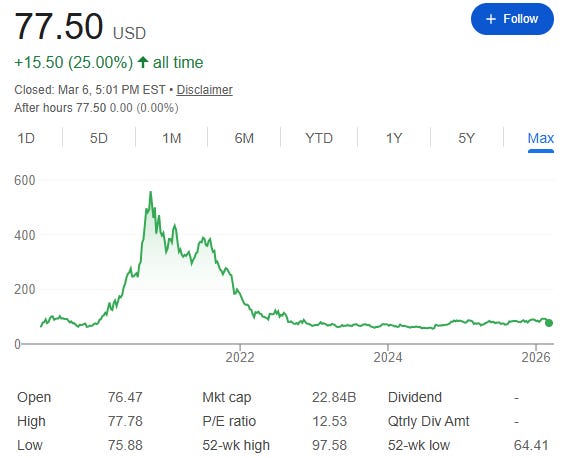
I saw a stock chart for Zoom recently and it made me reflect on how quickly life changed during the pandemic.
Almost overnight, everything went from “normal” to Zoom.
Work meetings were on Zoom.
My small group was on Zoom.
Even an impromptu trivia night with old college friends started happening on Zoom.
Before the pandemic, Zoom was mostly a work tool. It was something a few companies used for remote employees or client meetings. Most people I knew had barely heard of it.
Then suddenly everyone knew Zoom.
You had grandparents learning how to mute themselves, teachers running entire classrooms through it, friends hosting happy hours, churches doing services, and coworkers spending their entire workday there.
If you look at the stock chart, you can see the story pretty clearly. A massive spike when the world suddenly depended on it… and then a gradual return closer to normal as life opened back up.
But something did stick.
Even though Zoom’s hype settled down, the comfort with it never really went away. Today it’s mostly back to being a work tool again but now everyone knows what it is, how to use it, and doesn’t think twice about hopping on a video call.
In a strange way, that chart captures a moment in time when the entire world had to learn the same piece of technology all at once. -SW
Noticeable Decline in Customer Service
We’ve all felt it. You walk into a Taco Bell, and it feels like you’re an interruption. No one’s manning the counter, and employees are avoiding eye contact. You’ve been waiting 20 minutes for a bean burrito, too late to cancel the order on your app, and too much time sunk.
Before the pandemic, there was a certain standard of customer service we were accustomed to. But according to Forbes, we are currently in a “Customer Patience Crisis.” During the lockdowns, we all gave grace because the world was falling apart. Now, businesses have mistaken that temporary “grace” for a new, lower baseline of what we’re willing to accept—and sadly, we seem to be accepting it.
Companies realized they could operate with fewer staff and push “self-service” as a feature rather than a cost-cutting measure. For us, it means more time spent in the “help” queue and less time getting actual help. It’s a strange shift; we’re paying more than ever, yet service has never been worse. -KC
Bringing Food and Groceries to Your Car
One thing the pandemic really springboarded was curbside pickup.
Before 2020, grocery stores already offered online ordering and pickup, but it wasn’t used nearly as often as today. Most people still went inside the store like they always had. Restaurants were similar. Takeout existed, but pulling into a parking spot and having someone bring the order out to your car was not really the norm. I even remember a Domino’s commercial explaining their “carside delivery” option. The whole ad was basically: order online, park in a spot, stay in your car, and a worker will walk your pizza out to your car. At the time they actually had to explain the concept.
The pandemic did not start this trend, but it massively accelerated it. Grocery pickup and delivery usage has exploded. I found an article saying in August 2019, about 2 billion groceries were purchased online (pickup and delivery combined). By March 2025, that number had grown to 9.7 billion.
What is even more telling is how stores are adapting. Some new grocery stores are now being designed with side lots and dedicated doors specifically for pickup operations. What used to be a small add-on service is now significant enough that retailers are rearranging their square footage and parking lots to support it.
In other words, curbside for fast food and groceries is here to stay. -SW
Increased Home Involvement from Dads
If there’s a silver lining to the “two weeks that turned into years,” it’s what happened in our living rooms. Once remote work became the norm for many, something shifted among many dads in their twenties and thirties.
Research on millennial fatherhood shows that our generation is fundamentally redefining the role. Unlike the traditional “breadwinner” model, the trend seems to be that dads are striving for a more egalitarian approach. We want to be emotionally and practically present for our families, correcting the “absentee” mistakes we saw in previous generations. It’s a level of presence our own fathers, and their fathers, rarely had the option to have, and honestly, it’s one of the best things to come out of the pandemic. -KC
QR Codes
Another thing the pandemic accelerated was the use of QR codes.
QR codes were actually invented in 1994 in Japan. So the pandemic did not create them. But if we are being honest, how many people were actually using QR codes before 2020?
Now they are everywhere. At my church they are still used on the announcement slides, and there is a sticker with one on every chair so you can scan it to see the service guide. At work we have QR codes on almost all of our printed materials so people can scan them instead of typing a long URL into their browser. Restaurants still use them for menus, and most people do not even think twice about scanning one.
What amazes me is how quickly everyone learned how to use them. Almost overnight people understood that you could point the camera on your phone at a weird looking square and instantly get the information you needed.
That kind of behavior change almost never happens under normal circumstances. In many ways, it might be one of the greatest change management stories ever. QR codes are everywhere now, they are clearly here to stay, and I honestly do not think twice about using them anymore. -SW
Dadvice Weekly is Kyle and Skyler—two friends in their thirties, living in Colorado, settling into fatherhood and trying to stay sane. Every Tuesday we share what’s working in our homes: gear we use, routines we’ve tested, ideas we’re trying. It could be a recipe, a product that solved a problem, or just what we’re thinking about as dads.
If you have a tip, tried something we mentioned, or just want to say hi, reply to this email or message us on Substack. We read everything, and we’re always looking for what works. Glad you’re here.
Amazes ,me that hotels have gotten away with cleaning rooms only every-other-day now. What a huge cost savings for them, but prices haven't gone down. :(