

Dadvice Weekly #46 / DIY Car Maintenance
Dadvice Weekly - #46
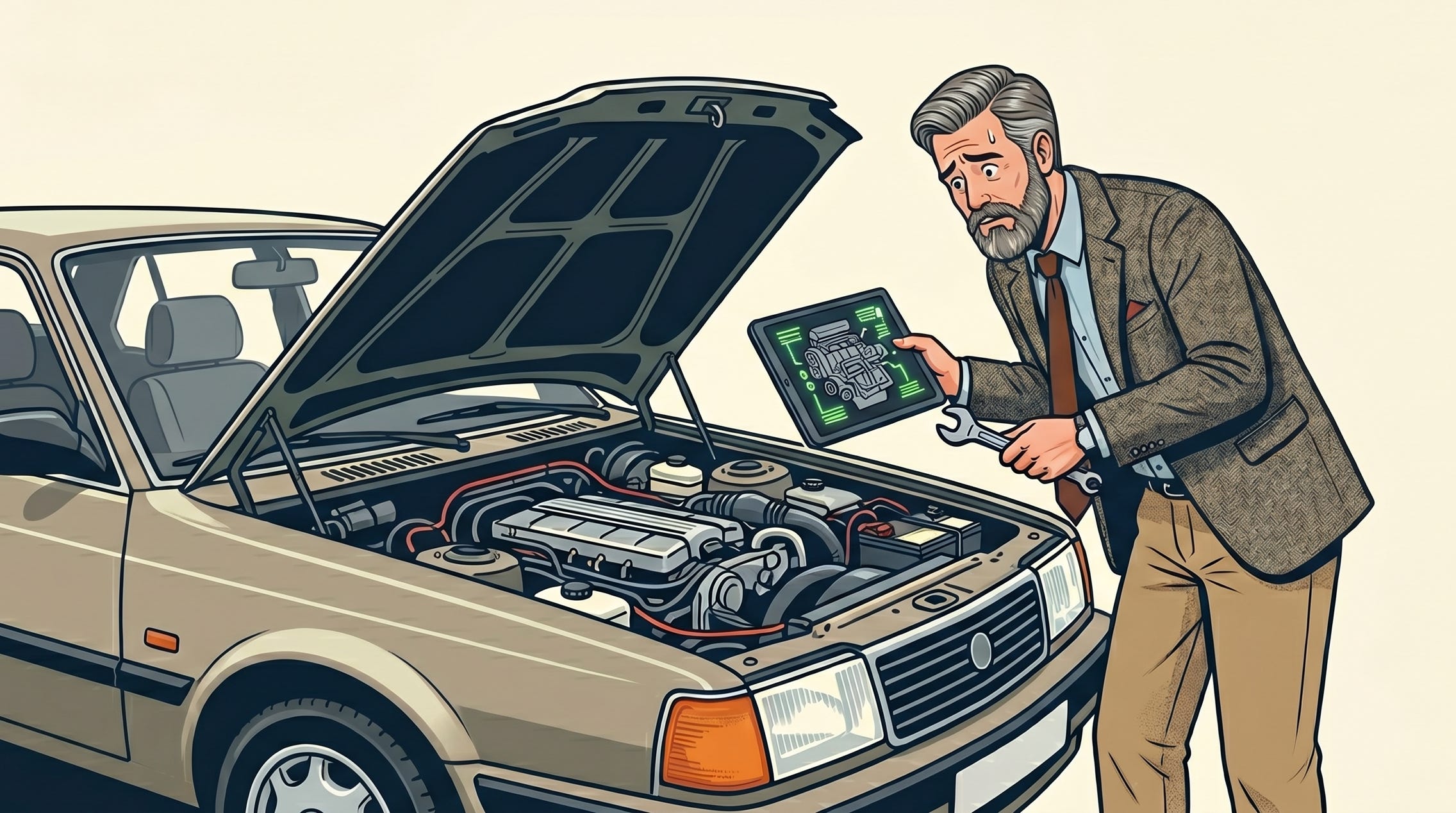
The oil change that broke me was $122.
I pulled the van in for a routine service and handed over my card without thinking too hard about it. Four kids, a packed schedule, and I just wanted it done. But on the drive home, something about the expense bothered me. It was a basic oil change. The kind of thing that, mechanically speaking, is about as complicated as making a pot of coffee. And I had just paid $122 for it.
That was the moment I decided to start figuring out my own cars, at least what I was reasonably capable of figuring out.
Both of ours have over 100,000 miles on them. They’re older, they need attention, and they are going to keep needing attention for as long as we drive them. Paying someone else to do every single thing that goes wrong is a financial strategy I can no longer justify.
A few months after that oil change, I took the Forester in for a tire rotation. The mechanic pulled me back to show me the lower control arm bushings that were worn out and cracking. His quote for parts and labor was just over $1,000. I thanked him, drove home, and typed “lower control arm bushing replacement Subaru Forester” into YouTube.
A weekend and maybe $180 in parts later, the job was done. I won’t pretend it was easy or that I wasn’t second-guessing myself the whole time. But it was done, it was done correctly, and I had just saved the better part of a thousand dollars.
That repair really shifted my perspective on car repairs. Since then I’ve replaced the intake manifold gaskets, done a full brake and rotor job, replaced ball joints, spark plugs, and started doing my own oil changes. What I’ve learned from these projects and research is that about eight tools and $350 covers roughly 80% of the maintenance and light repair work you can perform on your car at home.
What Tools Do I Need?
Before I get to the list, a few things I’m assuming you already have: a basic socket and ratchet set, a set of combination wrenches, and a screwdriver set in a few sizes. If you’ve done any home repair over the years, these are probably already in a drawer somewhere. If not, they’re cheap and easy to find at any hardware store, a Habitat ReStore, or a thrift shop.
Also worth covering before anything else: the basics that should be in place before you get under any car. Safety glasses, nitrile gloves, shop rags, a can of PB Blaster, and a tarp to lay under the vehicle. None of this is expensive. I buy nitrile gloves in bulk at Big R, 100 black gloves for around $7.
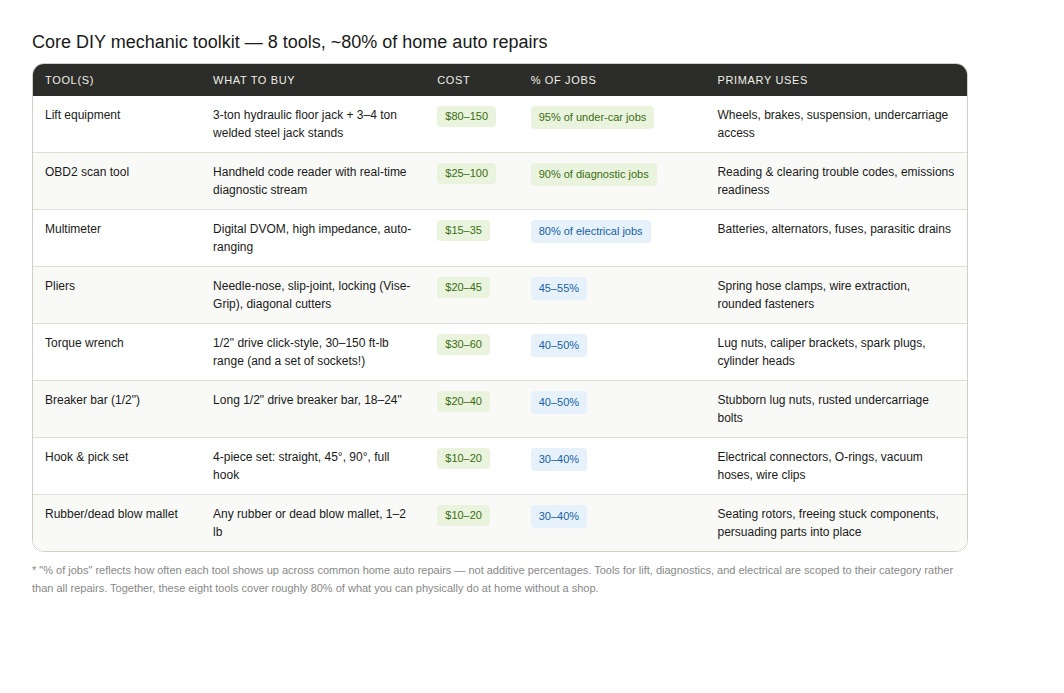
Lift equipment ($80-150). A floor jack and jack stands are the price of admission for any job that requires getting under the car. I’d tell you not to cut corners here more than anywhere else on this list. Buy rated equipment, use it on flat concrete, chock the wheels, and do a firm shake test before you slide underneath. Floor jacks and stands go on sale at Harbor Freight regularly and show up constantly on Facebook Marketplace. Budget around $200 for all new equipment, or about half that used.
OBD2 scan tool ($25-100). Before you take your car to a shop or start panicking about a warning light, plug one of these in. It reads the trouble code your car is throwing and tells you what the problem actually is. Half the time it points to something simple. In my experience a $15 scanner on Amazon is all you’ll ever need — you don’t have to spend $100 to get useful information out of it. This one tool has saved me several unnecessary shop visits.
Multimeter ($15-35). Most people don’t think about electrical diagnosis until something goes wrong and they have no idea where to start. A basic digital multimeter fixes that. It checks battery health, tests alternator output, traces fuses, and helps you track down parasitic drains that kill your battery overnight. They run $15–$35 and are useful well beyond cars once you own one. Buy a cheap one. It will work fine.
Pliers ($20-45). You need more than one kind. Needle-nose for tight spaces, slip-joint for general grip, Vise-Grips for holding or persuading things that don’t want to move, and diagonal cutters for wire work. I bought a pair of Channellock needle-nose pliers five years ago and use them almost every day for something. I also keep a small set of jeweler’s pliers in the toolbox for miscellaneous reaching in spots where nothing else fits. They’re cheap and earn their keep constantly.
Torque wrench & sockets ($30-60). Over-tightening a bolt causes just as many problems as under-tightening one. A torque wrench lets you hit the spec your vehicle requires — which matters on lug nuts, brake caliper brackets, and anything structural. Get a 1/2-inch drive click-style wrench in the 30–150 ft-lb range, and pick up a dedicated set of 1/2-inch sockets to go with it. The click tells you when you’ve hit the number. Stop there.
1/2” Breaker bar ($20-40). Some bolts have been on your car for ten years or more and they are not coming off with a ratchet. A long 1/2-inch breaker bar gives you the mechanical advantage to break them loose without burning out a tool or your wrist. It’s especially useful for lug nuts and anything on the undercarriage that’s been exposed to rust and road salt. Use it to crack the bolt free, then switch to the ratchet to finish the job.
Hook & pick set ($10-20). These sets look like dental tools and work like magic in an engine bay. The most common use is depressing the plastic locking tabs on electrical connectors without snapping them off, something fingers and screwdrivers both fail at regularly. They’re also useful for fishing out old O-rings, gaskets, and wire clips from places you can’t reach any other way. A four-piece set with straight, 45-degree, 90-degree, and full hook profiles covers most situations.
Rubber/dead blow mallet ($10). A regular hammer will damage whatever you hit it with. A rubber or dead blow mallet transfers force without leaving marks, which matters when you’re seating a rotor, convincing a stuck component loose, or tapping something into place that isn’t quite aligned. You will reach for this more often than you’d expect. They run $10–$20 and take up almost no space in a toolbox.
Nice to Haves
These are things you don’t have to have, but will make your jobs much easier if you do.
Impact driver ($150-200). Not required, but once you have one you’ll wonder how you got along without it. An impact driver makes fast work of rusty bolts and large fasteners that would otherwise destroy your wrists and your patience. The important thing: use it to break bolts loose and run them down quickly, then finish with the torque wrench. Don’t use an impact driver to final-tighten anything that has a torque spec.
Magnetic parts tray ($5). I genuinely cannot believe I went as long as I did without one of these. When you’re mid-job with greasy hands, having a magnetic bowl to drop bolts, clips, and small hardware into means you don’t spend twenty minutes hunting a 10mm across a concrete floor. They’re $5–$15. Buy one for the garage and one for the toolbox.
Headlamp ($10). Both hands free, light goes exactly where you’re looking. Under a hood or under a car you will use this on every single job. A cheap LED headlamp from Amazon works perfectly fine — you don’t need to spend much. It is one of those tools that seems obvious in retrospect and makes you wonder how you managed without it before.
The pattern I keep coming back to is the same one I see everywhere in dad life: the barrier to doing something yourself is almost always lower than it looks from the outside. The $1,000 bushing job that turned into a $180 weekend. The $122 oil change that I now do myself for $30 in forty minutes.
The tools are an upfront cost, but the knowledge is free on YouTube, and the savings compound every time you use either one. -KC
Dadvice Weekly is Kyle and Skyler—two friends in their thirties, living in Colorado, settling into fatherhood and trying to stay sane. Every Tuesday we share what’s working in our homes: gear we use, routines we’ve tested, ideas we’re trying. It could be a recipe, a product that solved a problem, or just what we’re thinking about as dads.
If you have a tip, tried something we mentioned, or just want to say hi, reply to this email or message us on Substack. We read everything, and we’re always looking for what works. Glad you’re here.