
I am not a financial advisor, but since graduating college in 2016 I have been fascinated with the world of investments.
I have read a lot of books, listened to a lot of podcasts, and have thought a lot about the best way to position my money to maximize my chances to retire early while not compromising the life I live today. This is not one-size-fits-all type of advice, but if you are someone who is interested in personal finance and are looking for strategies to follow, I hope this list helps you make decisions for what to do with your dollars.
In grade school there was a math concept called PEMDAS. It’s the order of operations for solving equations. Here’s what I believe to be the order of operations when it comes to maximizing your dollars with investment accounts when you are in your thirties.
Another way of looking at this is an alternative strategy to Dave Ramsey’s baby steps. Before I get into it, I generally agree with Dave Ramsey and his principles. There are some nuances I definitely disagree with, but in general if you need a strategy of something to do with your money that is as straightforward as possible, what he has going is solid. For people like me who have financial literacy, discipline to not go in debt, and is comfortable having a mortgage, I truly believe this is the best approach to managing your dollars.
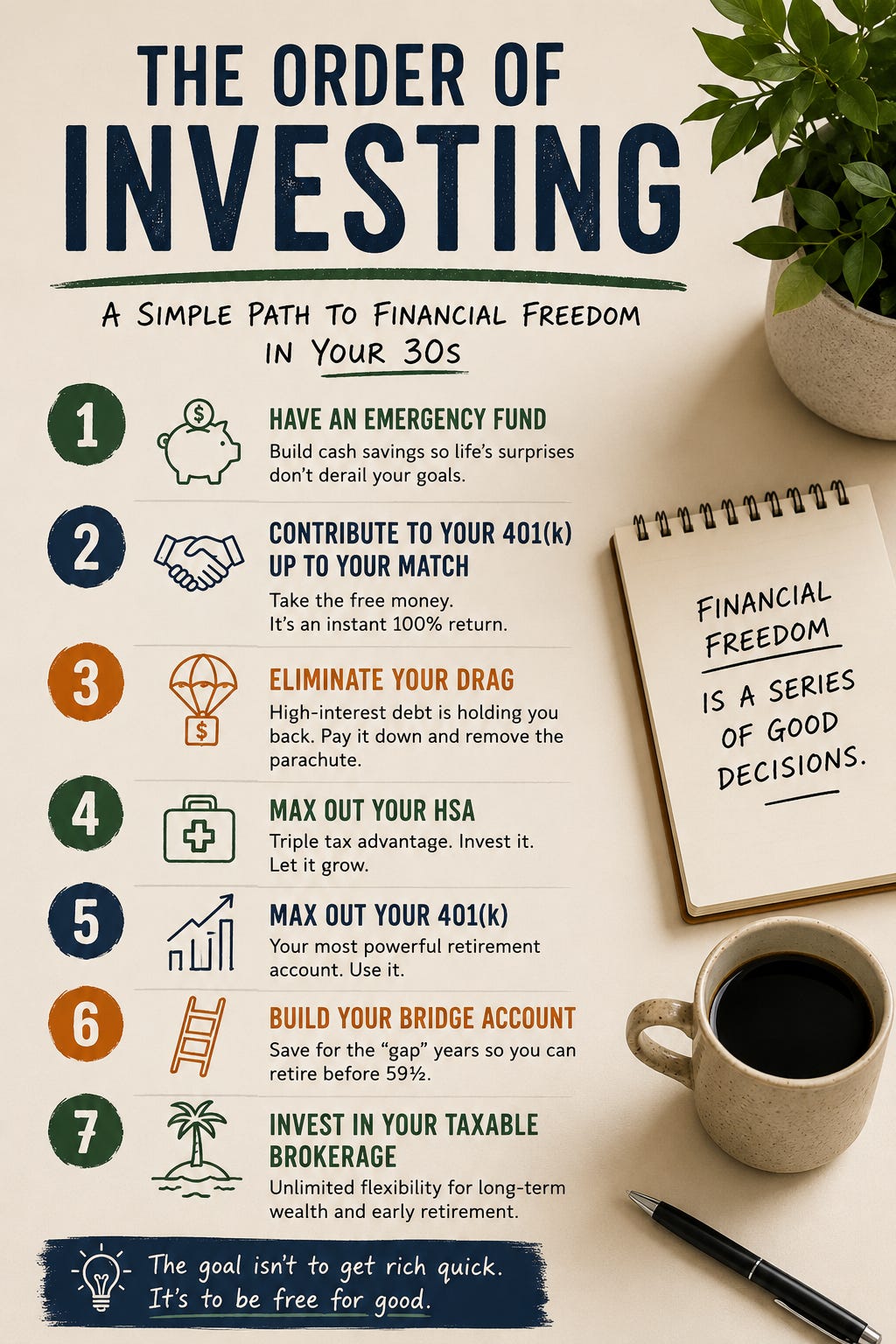
1. Have an emergency fund.
This allows you to not think about paying your bills on time, and if you were to lose your job you could float some money until you find your next one.
Dave Ramsey will say have 3-6 months as cash for your emergency fund. The crazy thing about that is 3-6 months is a significant amount of variance. Is it 3 months? Or is it 6 months? The difference between those two amounts is huge.
My 2 cents are if you are a DINK (double income no kids) then you can probably get by with an emergency fund of 1-2 months. You have enough cash in your bank account to pay all your bills, fix your car, if you were to lose your job but your spouse keeps their job you will be fine until you find your next job.
On the other side of the extreme, if you are the sole earner in your household and you have a few children having 4 months in cash is probably a wise decision.
For me personally I would advise to have enough in cash so you can pay all of your bills and not think about moving money around. Then have enough in cash where you can sleep at night knowing life is always going to be uncertain (as I’m writing this our AC just broke) and you have cash ready to go for an unforeseen expense. Then have some money sitting in a brokerage account tracking some bonds (look at tickers: BND and SCHD for example) to top you off in the event you lost your job.
The ultimate goal of this first step: to have money in hand where you don’t have to think about the minutia of bills, broken appliances, and whatever else life might throw at you. Have enough in cash to pay the the bills and broken appliances. Then have your “whatever life throws at you” fund in something earning more than the negligible interest your checking account earns.
2. Contribute to your 401(k) up until your match
I’m not going to go into detail on this one. I trust you know what this means. Take the free money your employer gives you.
3. Eliminate your drag
Drag is anything holding you back from having your money work for you that is over X% of interest that you personally define as drag. For me, I say anything 6% or more is considered drag. Your parlay loving cousin might say its 10%. Your Dave Ramsey purist friend would say its anything above 0%.
Regardless of your definition, I’m talking specifically about credit card debt, car loans, student loans, personal loans, medical debt, etc. that exceeds your definition of drag.
Financial independence is a marathon. Having debt paying 6% or more of interest is like running the marathon with a parachute on your back. That doesn’t mean there won’t eventually be opportunities for you to go onto the next steps, but before you do it makes a lot more sense to eliminate your drag.
4. Max out your HSA
We are now entering into the tax advantaged account steps.
One of the most underrated investment strategies is opting into a high deductible health plan (HDHP) and opening a health savings account (HSA).
Employers will typically have an option for you to opt into an HDHP. The downside of an HDHP is that you have to hit your deductible before your employer helps alleviate your medical expenses. The upside is that you are eligible to create and contribute to an HSA.
An HSA that can be opened through your employer or another financial institution. In my opinion this is the greatest account you can invest in while you are in your 20s and 30s. In 2026 you are able to contribute $4,400 for an individual or $8,750 for a family. The design of this account is you can spend this money on qualified medical expenses. The list of what a qualified medical expense is very long, but think of things like knee surgeries, visits to the doctor, fillings at the dentist, deodorant, first aid kits. There are so many things that qualify.
The HSA has 3 things going for it that no other account has:
1. The dollars you put into it are not taxed
2. You are able to invest the dollars in the account and those dollars will grow tax free
3. You are able to withdraw the money for qualified medical expenses regardless of your age (more on this later) with no penalty
A really great strategy is to have an HSA, max out your contributions every year, and never withdrawal from it unless you absolutely need it. As you accrue medical expenses, you save your receipts and at any point you can sell your investments in the HSA and withdrawal the cash of that investment.
At the very least, have an HSA and pay for all your medical bills right away with pre-tax dollars to save ~25% off your bill. At the most, you have medical expenses and save your receipts. At some point (5 years from now or 25 years from now) your money will grow tax free. You can then sell your investment and pay yourself back and use that cash to do whatever you want. I love this strategy over a Roth, Traditional IRA, and 529 because your money is not taxed going into the account, you can withdrawal it at any point assuming you have saved the receipt of your medical expense, and it grows tax free.
5. Max out your Roth IRA
If you google “what is better, a Roth IRA or a Traditional IRA?” you will be hit with pages and pages of posts and articles.
The TLDR: a Roth IRA is better to contribute to today if you anticipate your tax bracket to be higher in retirement than it is today. A traditional IRA is better if you anticipate your tax bracket to be lower in retirement than it is today.
The hardest part of knowing the answer to this is we know what the tax brackets are today. We have no clue what they will be in 30 years. So just in case, we should probably put money in both. In terms of this post, I think tax brackets are going to go up in 30 years which is why I’m prioritizing this as step #5 instead of the Traditional IRA.
A Roth IRA is an investment account where you contribute after tax dollars. Your investment will grow, and when you are 59 ½ you are able to sell those investments and put them into your bank account as cash.
The Roth IRA has 2 things going for it and two things going against it verse the HSA:
Bad thing - You deposit after tax dollars
Bad thing – you can’t get the money as cash until you are 59 1/2.
Good thing – It grows tax free so whatever money you make on your investments is yours to sell without any taxes
Good thing - You get taxed at the tax bracket you are at today. This offsets some risk of not knowing the tax brackets in 30 years.
In 2026 you are able to contribute $7,500 if you’re under 50 and $8,600 if you’re 50 or over.
Personally, I like investing in a Roth IRA over a 401(k) with a Roth option. The difference is with a Roth IRA, you have way more options of funds to invest in. IE – you can put it in a specific stock, a fund from Schwab, a fund from Vanguard, a fund from Fidelity. If you invest in your companies 401(K) that has a Roth option, you are limited to your companies’ financial broker’s set of funds.
6. Contribute to your 401(k) & 529
If you’ve made it this far you are probably wondering, what happened to the PEMDAS? You just threw like 2 things in one operation.
Up until this point I am pretty passionate that the order is set in stone. Once you get to this point, you have some choices to make. I am going to list 2 things that you have to personally prioritize based on your own psychology and family values. If you have an emergency fund, are contributing up to your match, have eliminated all drag, maxed out an HSA, and maxed out a Roth IRA then you are sitting incredibly strong financially. This is now the zone where you need to do what serves you the most. For me personally, I would do a combination of these 2 things.
Contribute to your 401(k) - specifically a Traditional IRA
You can’t go wrong putting remaining dollars into your 401(k). I like putting this amount in the Traditional IRA to offset the risk of future tax brackets with the Roth IRA in step 5. The Traditional IRA has the following characteristics:
Uses pre-tax dollars
Can be withdrawn at 59 1/2
All gains are going to be taxed
I like it more than a general brokerage account because its a tax advantaged account.
Contribute to a 529
If you have children and would like to pay for all or part of college it is wise to set up a 529 and contribute to it. We talked about this at length in issue #44. Do not feel like you need to max out the 529, but this should be a place to drop some dollars each month. The 529 has the following characteristics:
Uses after tax dollars
Grows tax free
Can be used on educational expenses and all remaining money will be converted to a Roth IRA for your child
7. Create a Bridge Account
If you are doing every step prior to this one in your 30s, the idea of retiring prior to 59 ½ (when you can withdrawal from your Roth IRA and Traditional IRA) is a very real option. So this step is really continuing to maximize your retirement savings while at the same time creating a path where you are able to retire early and have money to spend without penalties of withdrawing early from your retirement accounts.
This is basically a brokerage account where you manage buying/selling of stocks and indexes. It is not labeled “bridge account” by the financial institution. For me personally this is the lowest of priority in this list hence why it is step 7. But at the same time, it is something I am keeping in the back of my mind.
Creating a bridge account is step 7 for the following reasons:
It will use pre-tax dollars
It will be able to be withdrawn without penalty at the age of 59 1/2.
Your gains on taxes and dividends will have to be paid when they are recognized
The best advice I can give is to invest in an ETF that tracks some form of the market. Some of my favorite ETFs are ticker names: SPY, IVE, SPYD, and QQQ. Its not as flashy as a cryptocurrency, a hot stock like Nvidia, but these are going to be mindless investments that have a track record of growing in time with minimal expense ratios.
What Do I Do With This?
My encouragement to you is to determine if you agree with this order? If not, what is your order of personal finances? If you agree or don’t know what your order would be, follow this plan and I promise you that it will work for you. The most important thing though is to define where you are at within a plan, set a direction, talk to your spouse about it, and then execute.
Your thirties are a time where you have a lot of runway ahead of you, yet you aren’t fresh out of school. Taking some time to set a direction for your finances is one of the best uses of time. -SW
Anticipated FAQs:
1. What about rental properties?
Brooke and I bought a rental property in 2021 when we were DINKs. Rates were low, we had some extra cash, and it was a goal we had. I am intentionally leaving rental properties out of the above list due to current interest rates.
Since having it for the last 5.5 years, I think it has been a net positive! With that being said, I am now in an era where I prioritize my time. My Roth IRA has never called me that the hot water heater broke, the sewer lines are backing up, and mice were in the pantry.
I do think rental properties are great investments, but the math has to work. I’ll probably write more about this in the future but for now I would prioritize with the bridge account. The only way I would prioritize it higher is if you are in an area where rents can cash flow $300 or a month at the time of closing.
2. What about crypto, shorting stocks, and trying to beat the market
I’ve been investing for over 10 years now. At first I tried to beat the market thinking I had something magic. I can confidently tell you that the vast majority of your money should 100% be in a diversified ETF or mutual fund. There have been so many studies to say it is very hard to be the market for a single year. And of those who can do it, they are unable to beat the market for multiple consecutive years.
The mindset I have is aligned with Morgan Housel where in his book, “The Psychology of Money” he says, “I am a passive investor optimistic in the world’s ability to generate real economic growth. I’m confident over the next 30 years that growth will accrue to my investments.”
Dadvice Weekly is Kyle and Skyler—two friends in their thirties, living in Colorado, settling into fatherhood and trying to stay sane. Every Tuesday we share what’s working in our homes: gear we use, routines we’ve tested, ideas we’re trying. It could be a recipe, a product that solved a problem, or just what we’re thinking about as dads.
If you have a tip, tried something we mentioned, or just want to say hi, reply to this email or message us on Substack. We read everything, and we’re always looking for what works. Glad you’re here.